
Garages get hot. Really hot. In Texas, it’s often the hottest spot on the property. You might want a home office, a gym, or a workshop out there, but if it feels like an oven by noon, you won’t use it much.
You can open the garage door, sure. That lets in some air, but it lets in heat and dust too. A fan moves air around, but it doesn’t make the room any cooler.
So what works? A ductless mini-split is a good option. You don’t need to add ducts to your house, and a lot of models also heat the room in winter. That makes them handy for a space that needs its own comfort control.
But hanging a unit on the wall isn’t the whole job. The garage needs decent insulation, the unit has to be the right size, and the setup should match how you plan to use the room.
Here’s what to think about before you look into ductless mini split Temple TX homeowners can count on all year.
Why Is It So Hard to Keep a Garage Cool in Temple?
Picture a summer afternoon in Temple. The sun has hit your garage door for hours. The roof is soaking up heat, and the walls probably have little or no insulation.
Now try to work out or build something in there.
Most garages were made for cars and tools, not for people. They don’t have the same insulation, sealed windows, or airflow as the rest of the house. So they heat up fast.
And it gets worse once you start using the room for something new:
- Home gym: You give off a lot of heat when you work out. A treadmill adds more.
- Home office: Computers and monitors warm up a small room after a few hours.
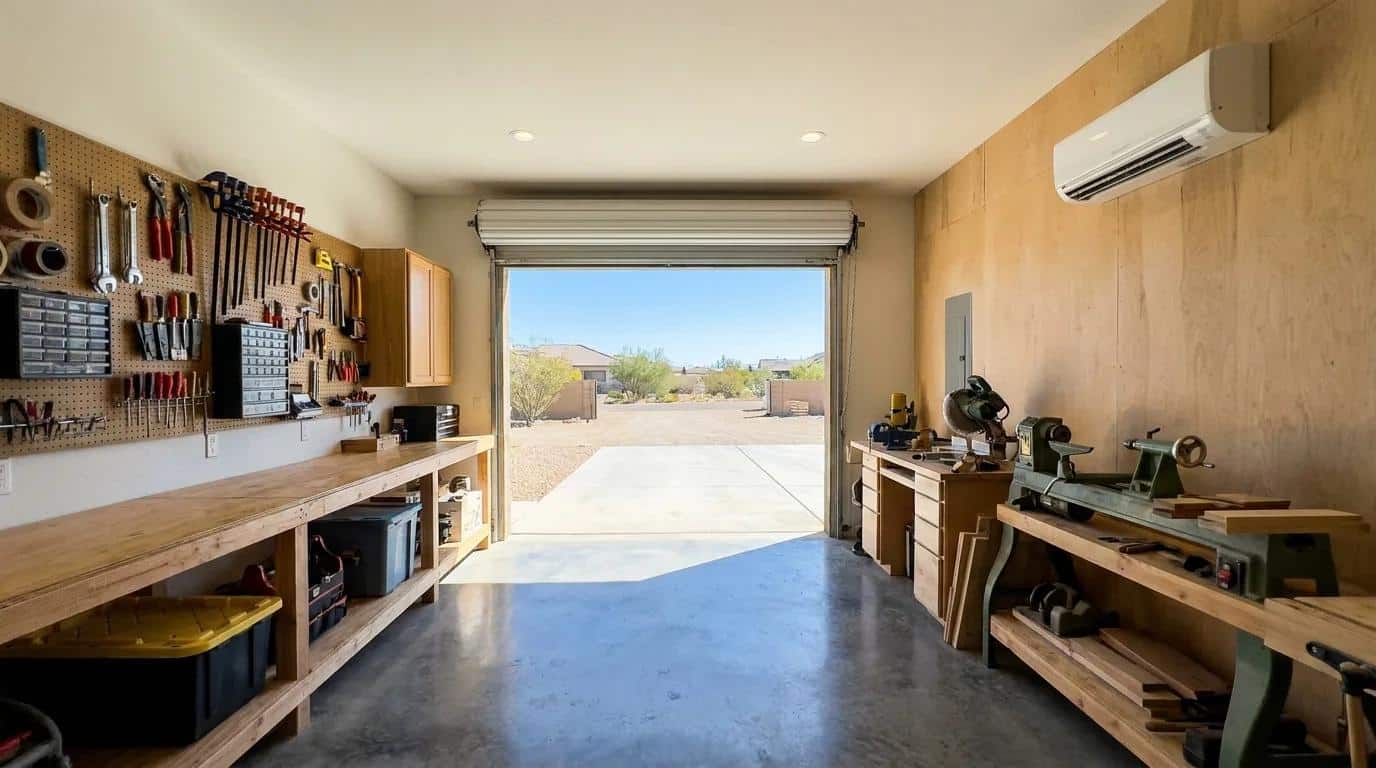
- Workshop: Tools and bright lights add heat, and dust makes the room harder to keep clean.
- Guest room: Guests need to sleep comfortably all night, not just for an hour in the morning.
- Hobby room: Sewing, painting, and crafts can keep you in there for a long time.
A conversion changes how you use the garage. So plan the cooling before you move your stuff in.
How Can a Mini-Split Help Cool Your Garage?
A mini-split has two parts: an indoor unit and an outdoor unit. Refrigerant lines connect them, so you don’t need ducts from your main system.
The indoor unit usually sits high on a wall. It pulls in the room’s air, cools it, and blows it back out. The outdoor unit pushes the heat outside.
The big plus for a garage is that it gets its own temperature control.
Say you use your garage office from 9 to 5 and barely go in after that. You can cool just that room. You don’t have to chill the whole house to match.
One thing to know: most mini-splits just recirculate the air in the room. They don’t bring in fresh air. If your workshop makes fumes or fine dust, you’ll need separate ventilation.
Many mini-splits are also heat pumps, so they warm the room in winter. That’s useful if you plan to use the garage year-round.
Is a Mini-Split a Better Choice Than Extending Your Existing Ductwork?

Not always. Both can work. It depends on how your house is laid out.
Extending your ducts sounds easy since you already have central air. But the garage might be far from the main unit, or there might not be space to run new ducts.
A mini-split might be the better pick if:
- The garage is separate from the rest of the house.
- There’s no easy way to run ducts.
- You want to control the garage temperature on its own.
- Your AC already struggles to cool the house.
- You don’t want to mess with your current duct system.
Extending the ducts might work if:
- The garage is close to the main system.
- There’s room for properly sized ducts.
- Your HVAC system has extra capacity.
- The new ducts can be sealed and insulated well.
Keep in mind that adding a vent doesn’t mean the garage will cool properly. Your system may not be big enough for the extra space, and it could even weaken the airflow in other rooms.
Have a temple HVAC repair pro to look at your system first. Then compare the cost, comfort, and energy use of both options.
Does Your Garage Need Insulation Before You Install a Mini-Split?
Yes. Insulation should be part of the plan.
A mini-split takes heat out of the room, but it can’t stop heat from coming in through the walls, roof, windows, or gaps around the door. If the garage heats up quickly, the AC will run nonstop just to keep up.
Check these spots first:
The garage door. If you’re keeping it, see if it can be insulated and sealed. If you’re replacing it with a wall, that wall needs insulation too.
The ceiling. Heat from the roof makes a big difference. Good ceiling insulation slows it down.
The walls. See if there’s any insulation in there, and whether it’s the right kind for your walls.
Windows and doors. Look for gaps around the frames. Worn seals let hot air in and cool air out.
Small openings. Gaps around pipes and wires should be sealed with the right materials.
In Temple, where the heat sticks around for weeks, these fixes really add up.
They can also change what size unit you need. A tight, well-insulated garage needs less cooling than a leaky one the same size.
If you’re turning the garage into a bedroom or living space, check the local building and permit rules before you start. Insulation, exits, and electrical work may each have their own requirements.
What Size Mini-Split Works Best for a Garage or Workshop?
This is where a lot of people make an expensive mistake.
It’s tempting to pick a unit based only on square footage. But two garages with the same floor area can need very different systems.
A shaded, insulated garage used as a quiet office is nothing like a sunny garage packed with workout gear. A workshop with a few people and hot tools needs more cooling than a room used for storage.
Your installer should look at:
- The room’s size and ceiling height
- How well the walls and ceiling are insulated
- The type and condition of the garage door
- How many windows there are and how much sun they get
- How many people use the room
- Heat from computers, tools, lights, and equipment
- How often the outside door opens
A unit that’s too small will struggle on the hottest days. A unit that’s too big can switch on and off too often, depending on the model. That hurts comfort and doesn’t remove moisture well.
Don’t guess. Ask for a load calculation. It tells you how much cooling the room really needs.
When you compare quotes for ductless mini split installation Temple TX, ask how each contractor picked the size. If they can explain it clearly, that’s a good sign they looked at your actual room.
What If You Use the Garage for a Gym or Workshop?
How you use the room matters more than its size.
Think about a home gym. It feels fine when you walk in. Half an hour into a workout, you’re sweating and the room feels ten degrees warmer. A workshop does the same thing once the tools have been running a while.
So tell your installer what you’ll actually be doing out there. “It’s a garage” isn’t enough.
For a gym, say how many people train at once and what equipment you’ve got. For a workshop, list the tools and lights, since they all put out heat.
Where the indoor unit goes matters too. You want air to move across the whole room. You don’t want it blasting into a shelf or a big machine.
Also, a mini-split only handles temperature. Wood dust, paint fumes, and chemical smells are a separate problem. It won’t replace a dust collector or an exhaust fan.
If you work with anything that gives off fumes, ask about ventilation for that. And follow the safety rules that come with your tools and materials.
Will a Mini-Split Increase Your Electric Bill?
Yes, it uses power. How much depends on how you run it and how well the garage holds its temperature.
The good part is you don’t have to cool the whole house just to make one room comfortable. You also skip the loss you get when air leaks out of old ducts on the way to the garage.
Still, nobody can promise you a set amount of savings. If the garage is poorly insulated, it’ll take a lot of cooling no matter how efficient the unit is.
A few things help keep the bill down:
- Seal the gaps before the install
- Get an efficient unit that fits the room
- Set a steady temperature and leave it
- Clean the filter when the manufacturer says to
- Keep leaves and junk away from the outdoor unit
- Get it serviced now and then
And don’t count on the mini-split to fix everything. If your garage door lets in hot air or your ceiling has hardly any insulation, deal with that first if you can.
What Should You Check Before Installation?
Take a little time to plan before the installer comes. It saves hassle later.
Here are some things to ask yourself:
- Where will the desk, weights, workbench, or guest bed go?
- Is there a clear wall for the indoor unit?
- Is there a spot for the outdoor unit with good airflow and room for service?
- Can the electrical supply handle the system?
- Can the water drain be routed safely?
- Does the garage need more insulation or sealing?
- Will the conversion need a permit or other building work?
Noise is worth a thought as well. In a home office, you probably don’t want the unit right over your desk. In a guest room, don’t point the airflow at the bed.
Plan around how the room is laid out, not just where the equipment is easiest to mount.
How Do You Keep a Garage Mini-Split Working Well?
Garages get dusty, and workshops get worse. If you sand wood, cut materials, or run tools that throw dust, clean the indoor filter more often than usual.
Follow the manufacturer’s directions for that. A dirty filter blocks airflow, and then the unit doesn’t cool as well.
Keep the area around the outdoor unit clear. No stacked boxes, no tools piled against it, and sweep away leaves.
Watch for trouble signs. Water dripping from the indoor unit, weak cooling, or odd noises all mean it’s time to call a pro. Leave the electrical and refrigerant parts to them.
A bit of regular service catches small problems early, before they turn into a big repair bill.
Frequently Asked Questions
Can one mini-split cool a two-car garage?
Often, yes. It depends on the size, insulation, layout, and how much heat the room makes. A load calculation will show if one indoor unit is enough.
Can I use a mini-split in an unfinished garage?
Maybe. But unfinished garages heat up fast. Check the insulation, air leaks, electrical supply, and local rules first.
Will a mini-split cool a garage gym during summer?
Yes, if it’s sized for the room and for the heat from people and equipment. Good insulation and airflow help a lot.
Does a mini-split bring fresh air into the room?
Most don’t. They just recirculate the air that’s already in there. If your workshop needs fresh air or an exhaust for dust and fumes, plan that separately.
Can a mini-split heat a garage in winter?
Many can. A lot of them are heat pumps, so they heat and cool. Check the heating performance of the model you’re looking at.
Is a mini-split worth it for a garage conversion?
It can be, especially if you use the space a lot and want its own temperature control. It comes down to install cost, insulation, how you use the room, and what your current HVAC can handle.
Make Your Garage a Space You Can Use Comfortably
A garage conversion should give you a room you actually use, not one you avoid every summer.
A ductless mini-split is a solid way to cool a home office, gym, guest room, or workshop in Temple. But look at the whole space, not just the unit. Good insulation, the right size, a proper install, and regular upkeep all count.
If you’re planning a conversion, first decide how you’ll use the room. Then have the space checked before you choose equipment.
Ready to talk it over?
At Rohde Air Conditioning & Heating, we can help you look at ductless cooling for your garage or workshop. Get in touch to talk about your space, ask about installation, and find a system that fits.


